Mirjam Thomann
TIMES
23.10.2026 - 19.12.2026
The exhibition centers around a large-scale monochrome, the golden Door, 2026. It is the same scale as a standard door and was made with colored pencils, stroke by stroke, layer by layer, day by day. By the end of summer, Door eventually was mounted and framed. Now it is leaning against the wall of the exhibition space¾a wall that actually is a door itself. The exhibition is happening in a small space with no windows but several doors. It is like a box with unexpected openings. Some are clearly visible, some are rather hidden. In architecture, a door is a movable barrier, such as a sliding, folding, or revolving panel. It controls and regulates access, passage, light, sound, and climate. It also certainly is a social device. In The Same Door,Sara Ahmed writes, to reflect on the usability of doors is to reflect on who a world is built for and how bodies are shaped through habits that are repeated over time. Like passing a door on a daily basis. Or walking through it again and again. The swinging door at the entrance of the exhibition space is like a reminder of this temporal condition of each and every threshold. Surely, you want to be there when the door opens.
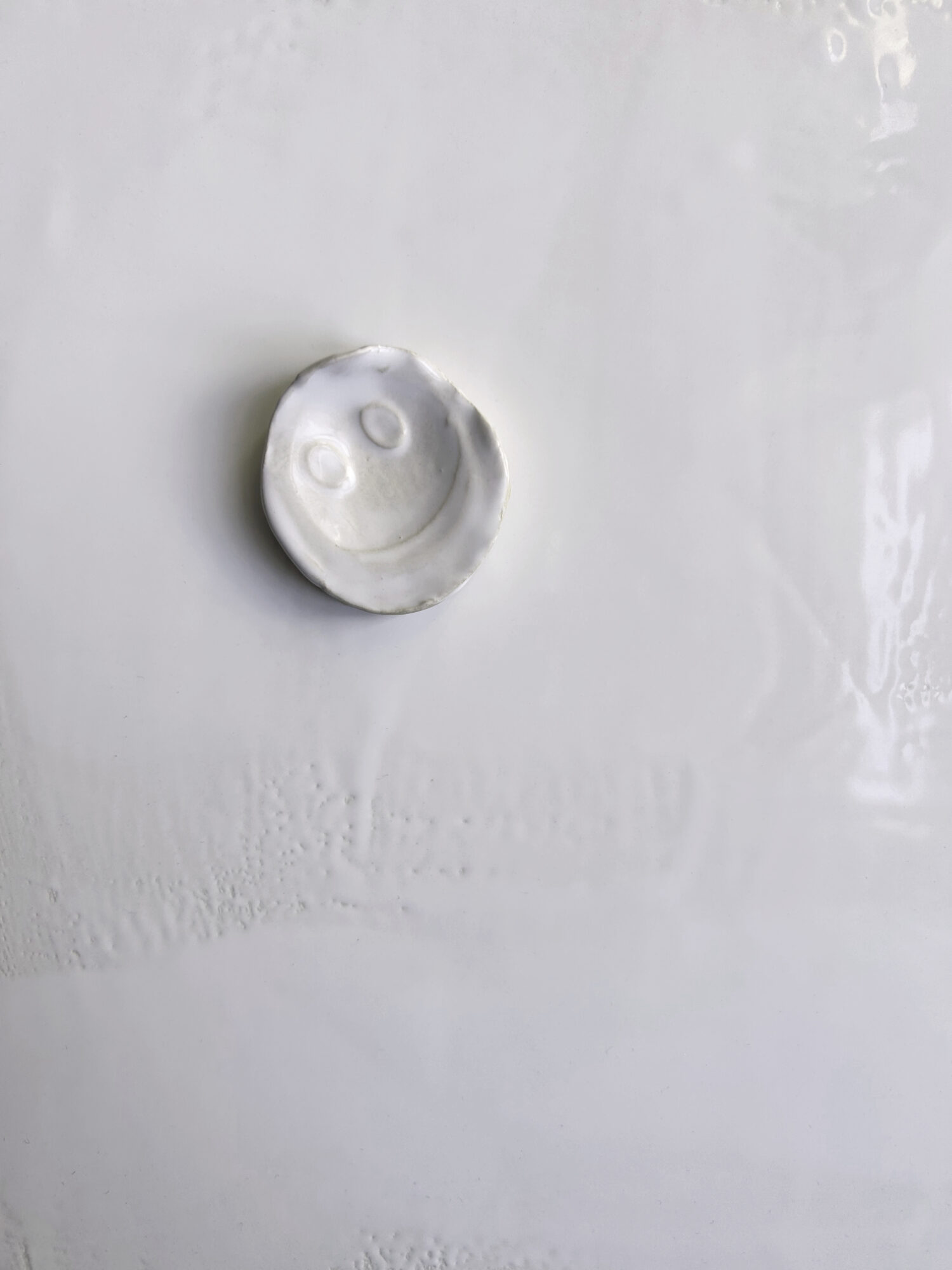
The group of ceramic sculptures positioned on a wooden plinth seem to be drawn towards Door. They are made up of different parts, the basic element is Vase Halle. It is a design from 1931 by Marguerite Friedlaender-Wildenhain, who was a student at Bauhaus in Weimar and taught at the ceramic workshop of Burg Giebichenstein in Halle. In 1933 she was forced to emigrate and settled in California, where she continued teaching, publishing, and studying ceramics until the 1980s. Vase Halle is still being produced today in different sizes and finishings by KPM, Königliche Porzellan-Manufaktur Berlin. The vessel consists of two basic geometrical forms, a sphere and a cone, which are clearly distinct from one another, yet blend into each other seamlessly at the same time. In an ongoing process of imitation and translation, the original vessels have been examined, expanded, and combined with industrially produced ceramic blanks, their hand-molded copies, as well as found ceramic pieces from Vienna that have been collected in the days leading up to this exhibition. Now the pieces are loosely stacked into towers. This storage method is used by ceramics shops in Taiwan, where a first version of this work was realized in 2013 for an exhibition at MoCA Museum of Contemporary Art Taipei. It’s been a while.
The text work in the corner is showing excerpts from a book titled Mirjam Thomann. Text, Space, a collection of writings that will be published by Bom Dia, Berlin, this winter. The texts, written over the last decade, revolve around the relationship between spatial structures, material conditions, bodily experiences, and processes of orientation. Next to doors, other basic architectural elements appear frequently in these texts, like columns, steps, walls, and windows.
Mirjam Thomann lives in Berlin. She is interested in reflecting on and transcending architectural, social, and institutional orders with the means of sculpture, installation, and text. In her works, she uses what is at hand at a certain site as an impetus, as material, space, and terrain, which she expands, supplements, or comments on. Her work was recently shown at the Kunstraum of Leuphana University Lüneburg, Klosterruine, Berlin (together with Nora Schultz), After the Butcher, Berlin, and Galerie Nagel Draxler, Berlin, and Cologne. This is her third presentation with Krobath after the solo exhibition Women and Space in 2016 and the group show Milieu, 2018 (curated together with Jenni Tischer). Thomann studied at Kingston University of London and Hochschule für Bildende Künste Hamburg. Since 2024 she has been a Professor for Artistic Practise with an Expanded Concept of Material at University of Cologne.
Further informations: